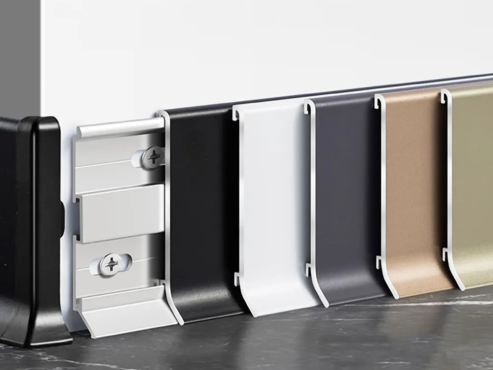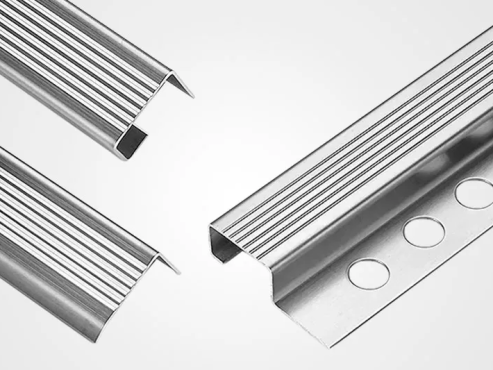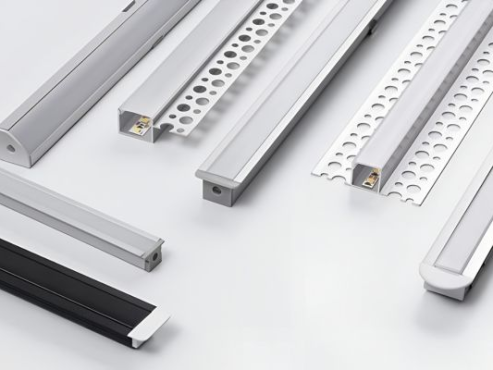
This is where metal stair edge nosing becomes important. A correctly selected profile protects the front of the tread, improves grip, defines the step edge, and helps control the geometry of the stair.
However, not every metal stair edge nosing works in the same way. The material, profile shape, installation method, surface insert, and local code requirements all affect performance. This guide explains the main options and the details that should be checked before specification or bulk purchasing.
What Is Metal Stair Edge Nosing?
Metal stair edge nosing is a formed or extruded profile fitted to the leading edge of a stair tread. Depending on the design, it may cover only the corner, extend across part of the tread, or incorporate an anti-slip insert or lighting element.
The profile performs two jobs at the same time. First, it protects the vulnerable stair edge from wear and impact. Second, it creates a more controlled walking surface at the point where the foot meets the step.
For new construction, metal stair edge nosing can be embedded into tile adhesive or other flooring systems during installation. For renovation work, a surface-mounted profile can be fixed over an existing stair edge. The right method depends mainly on the substrate, finish thickness, and project stage.
Why Metal Stair Edge Nosing Improves Stair Safety

A stair nosing cannot make an unsafe staircase compliant by itself. Riser height, tread depth, lighting, handrails, and maintenance still matter. But the edge profile can address several common problems.
- It makes the step edge easier to identify. A visible edge helps users judge where one tread ends and the next begins. Contrast is especially useful on stairs with similar tread and riser colors.
- It can improve traction. Grooved metal surfaces, rubber inserts, or abrasive inserts can add grip where the front of the tread receives concentrated foot contact.
- It protects the geometry of the step. Chipped tile, broken concrete, or worn wood can gradually change the feel of the leading edge. Metal stair edge nosing provides a durable protective line and helps slow this type of damage.
For busy stairs, the practical value is usually not one single feature. It is the combination of edge protection, visibility, and traction.
Common Materials for Metal Stair Edge Nosing
Aluminum Stair Edge Nosing
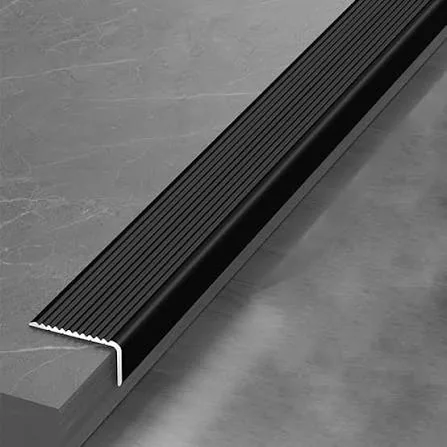
Aluminum is one of the most practical choices for general commercial and residential projects. It is lightweight, easy to cut on site, and suitable for extrusion into detailed shapes. Anodized or powder-coated finishes can also provide different colors and improve surface durability.
For distributors and project buyers, aluminum metal stair edge nosing is often easier to standardize across multiple projects because profile dimensions, finishes, punching patterns, and insert channels can be customized during production.
For exterior use, the finish should be selected carefully. Anodized aluminum is commonly preferred where better weather and wear resistance are required.
Stainless Steel Stair Edge Nosing
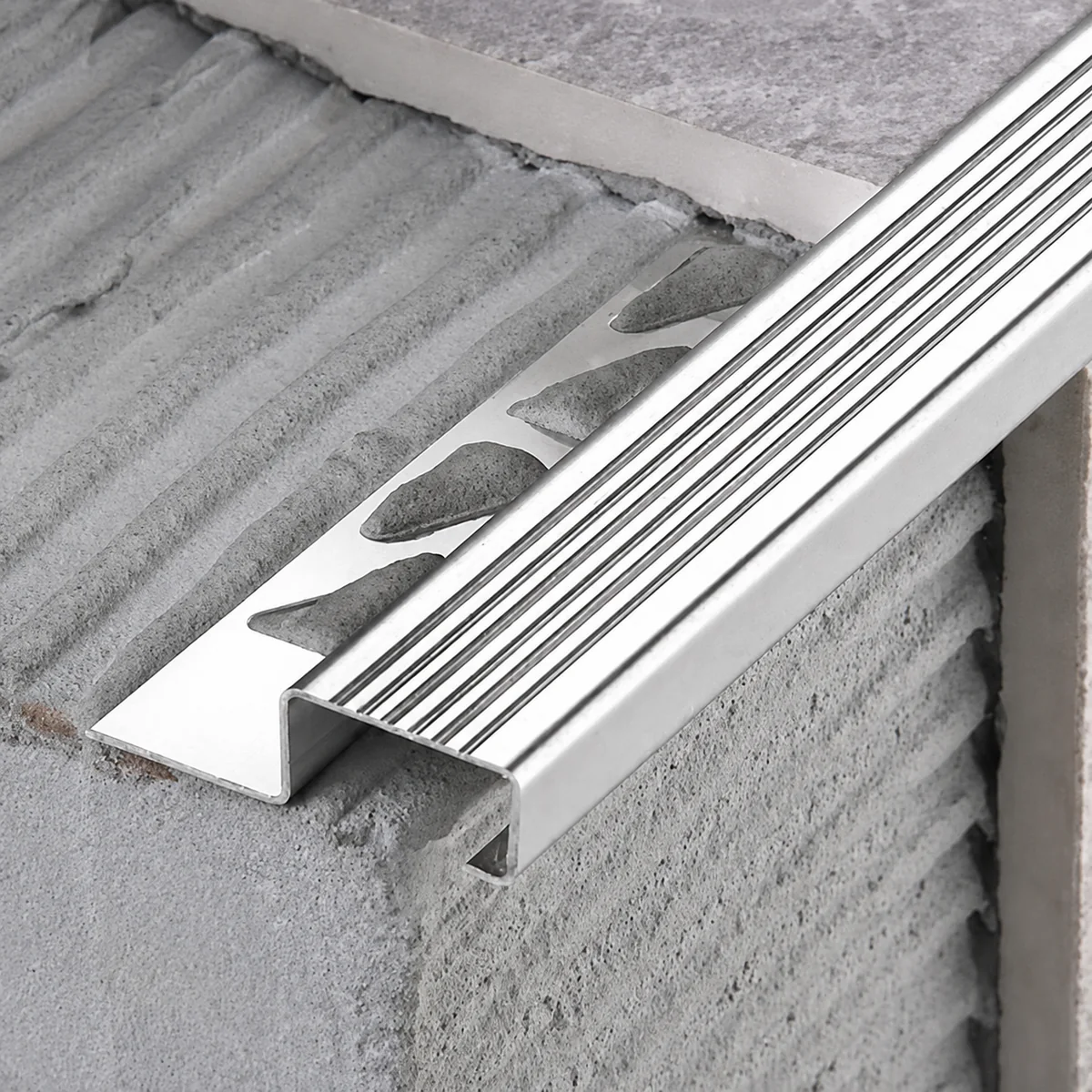
Stainless steel is useful where the edge will face heavier impact, frequent cleaning, or a more demanding environment. Grade selection matters. Grade 304 is common for many interior applications, while Grade 316 may be considered where chloride exposure or a more corrosive environment is expected.
Stainless steel metal stair edge nosing is normally heavier and harder to cut than aluminum, but it offers high surface hardness and a clean architectural appearance.
Brass Stair Edge Nosing
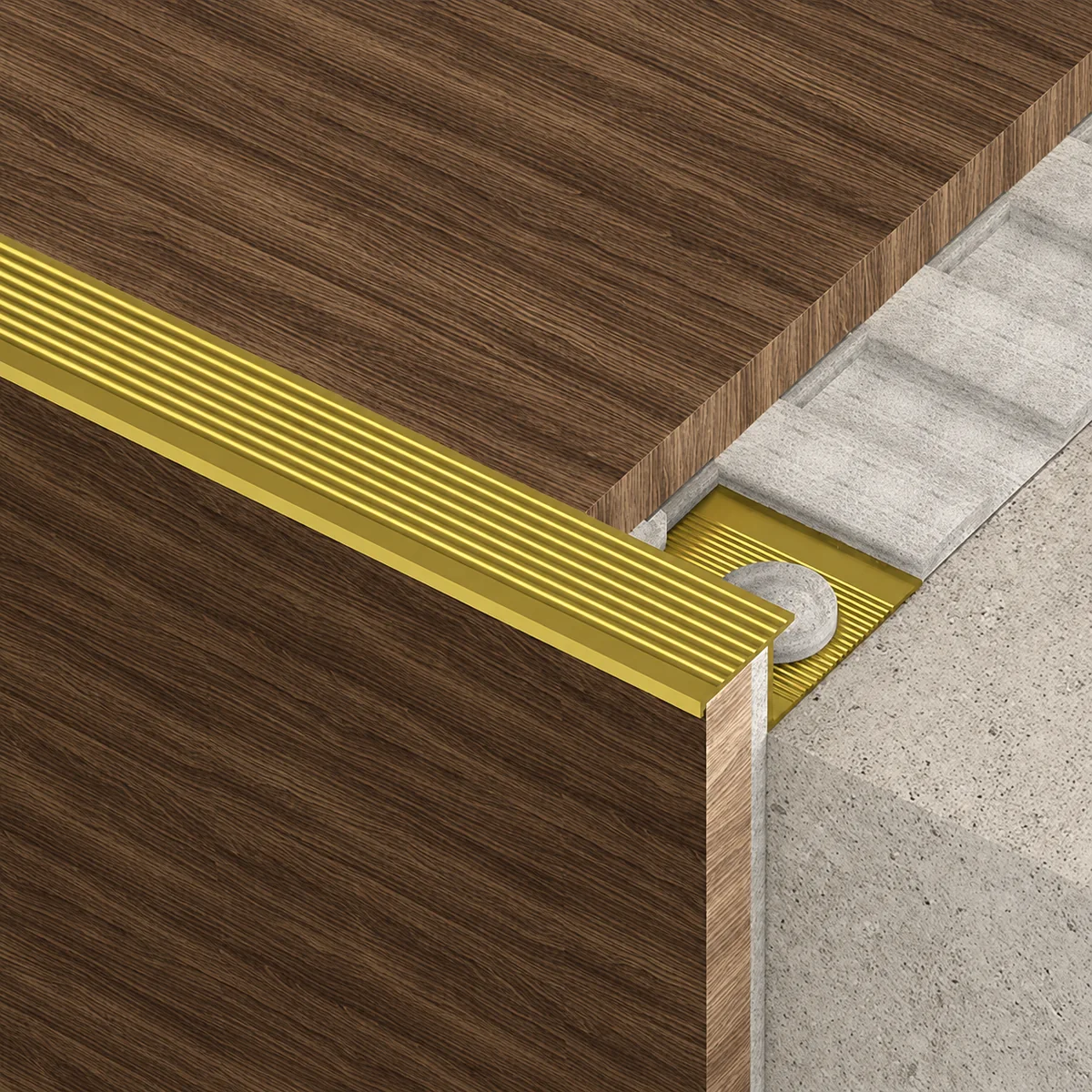
Brass is selected mainly where appearance is part of the specification. It provides a warm metallic finish and develops a natural patina over time unless the surface is protected and maintained.
It is generally more expensive than aluminum, so it is usually specified for decorative interiors rather than as the default solution for every staircase.
Main Metal Stair Edge Nosing Shapes
Profile shape affects appearance, foot clearance, edge protection, and compatibility with the stair construction. A shape should never be selected only from a product photo. A cross-section drawing is much more useful.
Square Edge
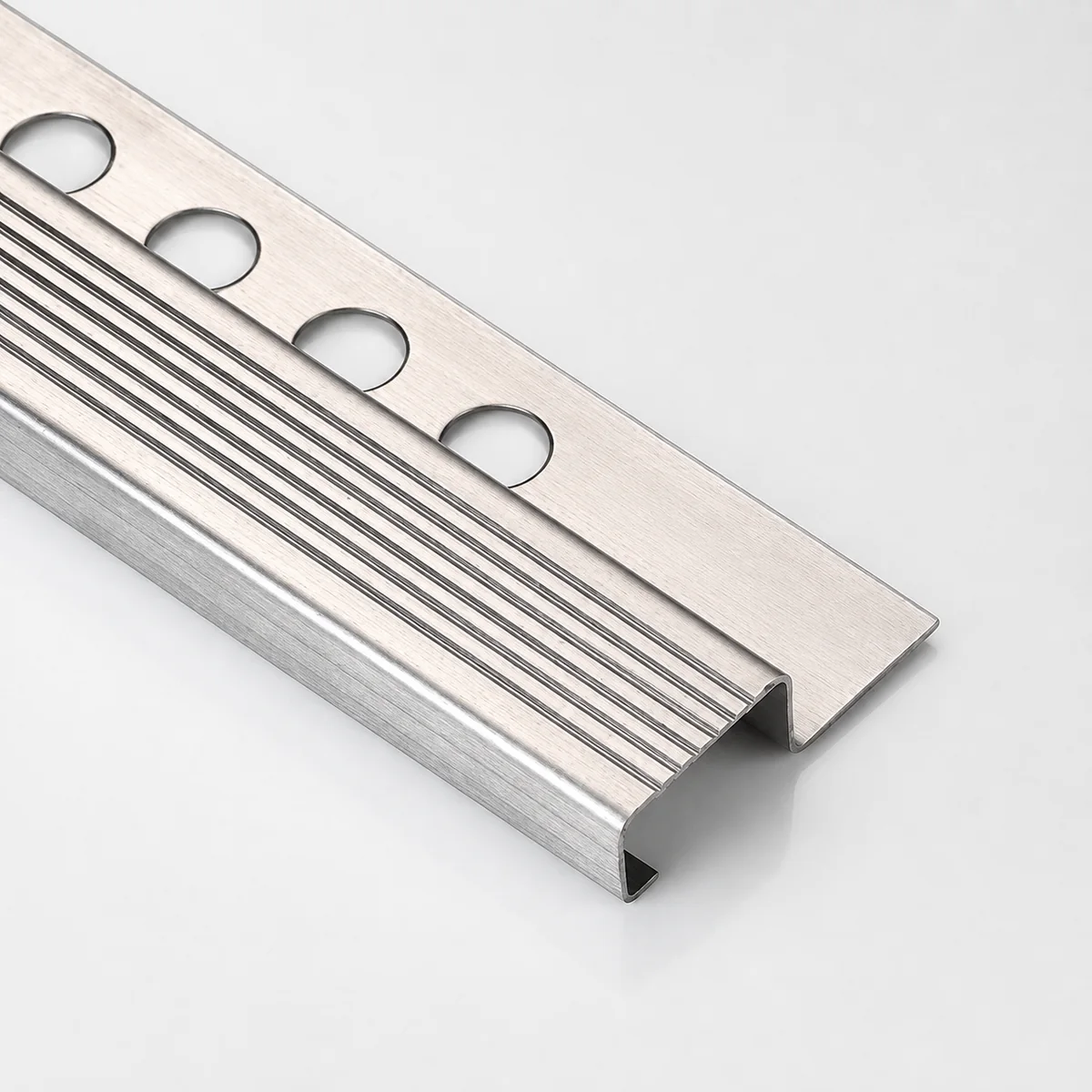
A square-edge profile creates a straight, modern line at the front of the tread. It works well with rectified tile, stone, and contemporary flooring details.
The important point is that the exposed corner should still comply with the required nosing radius or bevel. A visually square profile does not mean the leading edge should be dangerously sharp.
Square metal stair edge nosing is often used as a tile-in profile because the anchoring flange can be embedded beneath the floor finish.
Bullnose or Half-Round
Bullnose profiles use a larger curved front. They soften the visual line of the step and can wrap further around the tread edge.
This shape can suit thicker finishes or stairs where a rounded appearance is preferred. However, more rounding is not automatically safer. Excessive rounding can reduce the effective tread depth, so the profile still needs to be checked against the stair geometry and local code.
Pencil Round
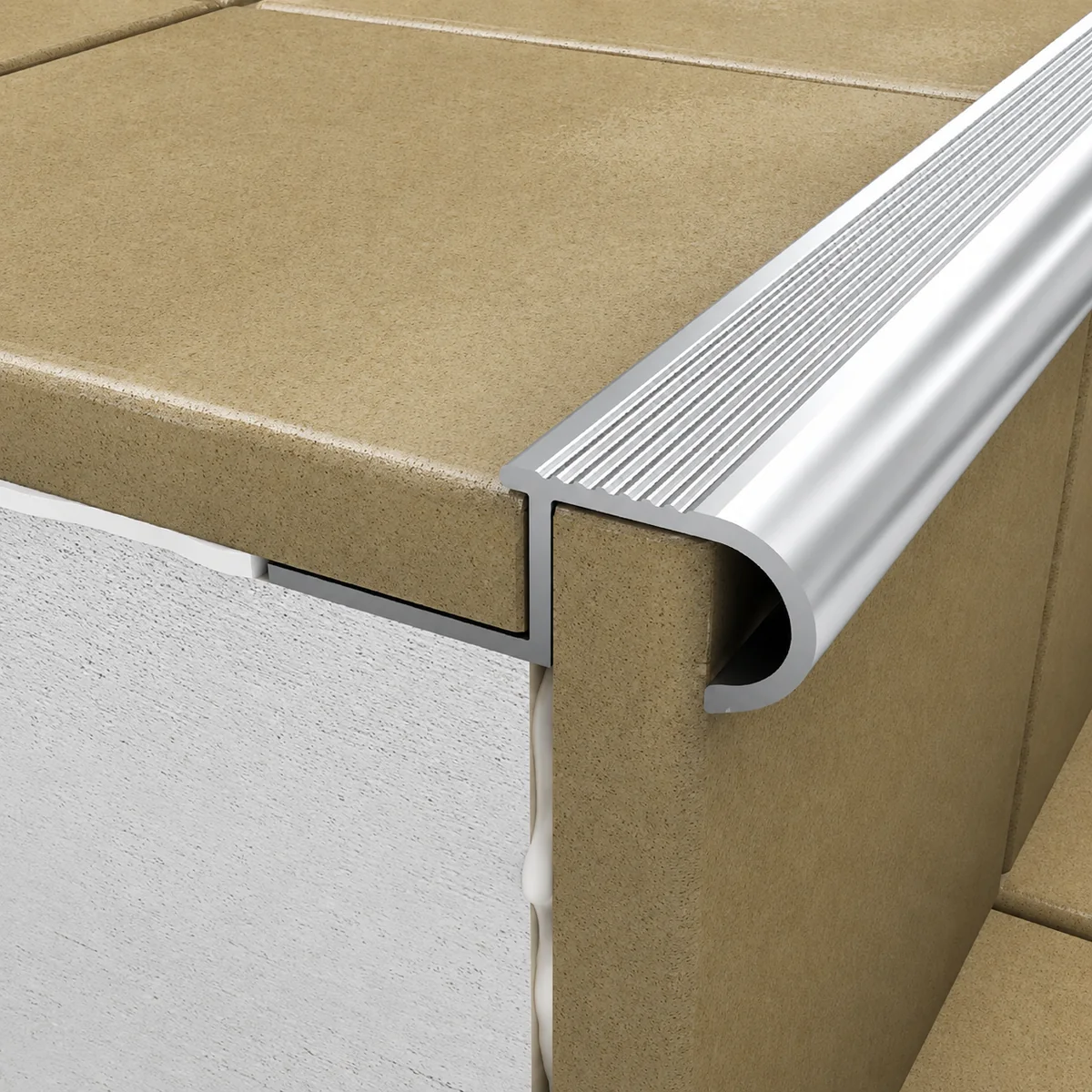
Pencil-round profiles sit between square and fully rounded shapes. The main face remains straight, but the leading corner has a small radius.
This is often a useful metal stair edge nosing option when the design calls for clean lines without a sharp 90-degree exposed corner. It also gives manufacturers more flexibility when matching other architectural metal profiles.
L-Shaped or Angle Nosing
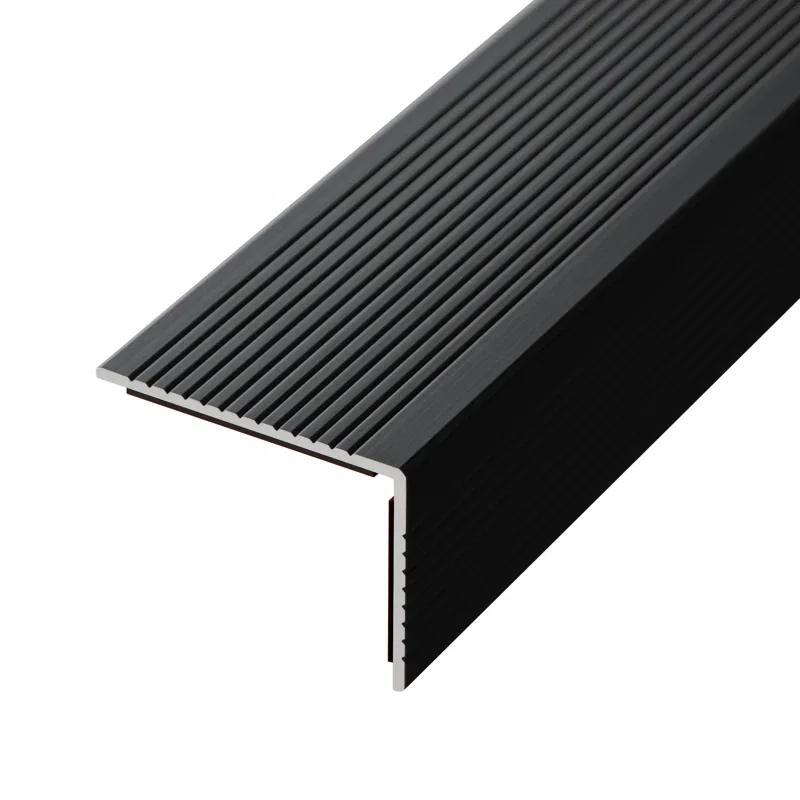
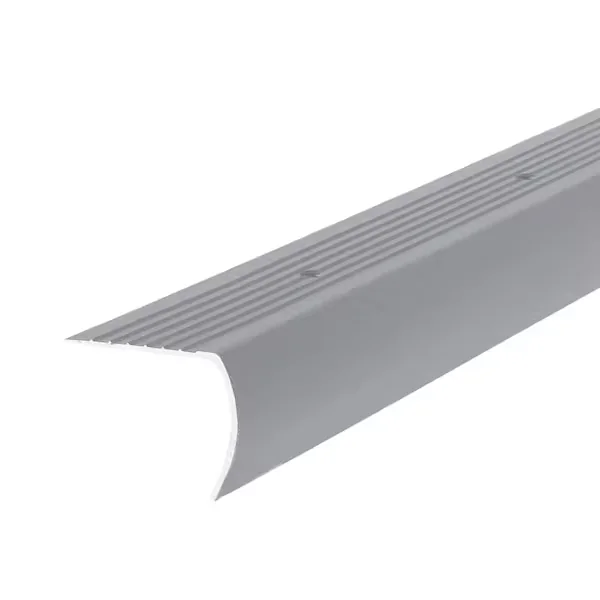
An L-shaped profile covers the horizontal tread edge and turns down over the riser. It is one of the simplest shapes for retrofit work.
Because it can be installed over an existing finished stair, this metal stair edge nosing is useful when the original edge is worn or when additional slip resistance is needed without removing the full floor finish.
The thickness of the top leg still needs attention. A retrofit profile should not create an abrupt raised lip that becomes a new trip point.
Rakeback or Slanted Nosing
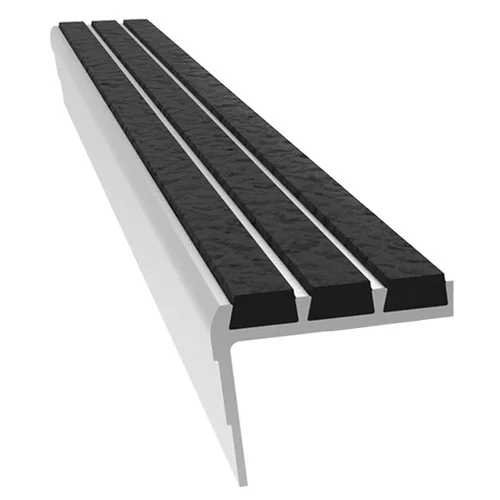
Some stair risers slope backward rather than dropping vertically. A rakeback profile follows this angle so the front face sits closer to the riser.
This shape gives a cleaner fit than forcing a standard 90-degree angle over a sloped stair. For custom metal stair edge nosing, the manufacturer normally needs the tread and riser dimensions, the riser angle, floor finish thickness, and required projection before preparing the extrusion drawing.
Other Functional Types of Metal Stair Edge Nosing
Shape is only one part of the specification. The walking surface can also be designed for different safety needs.
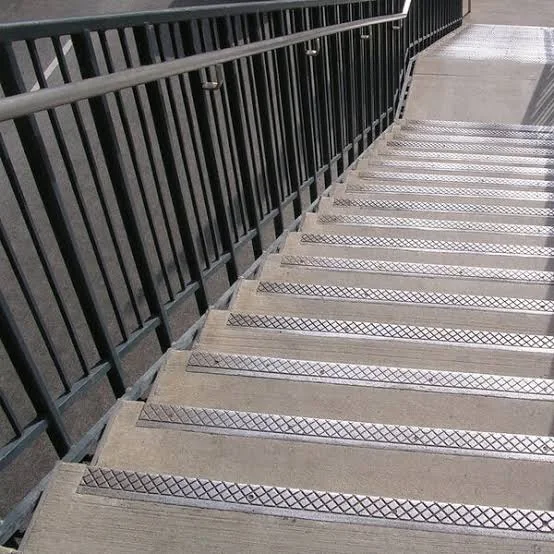
A grooved metal profile uses ribs or channels in the metal itself. It is simple and easy to maintain, but the actual slip performance should be verified for the intended environment.
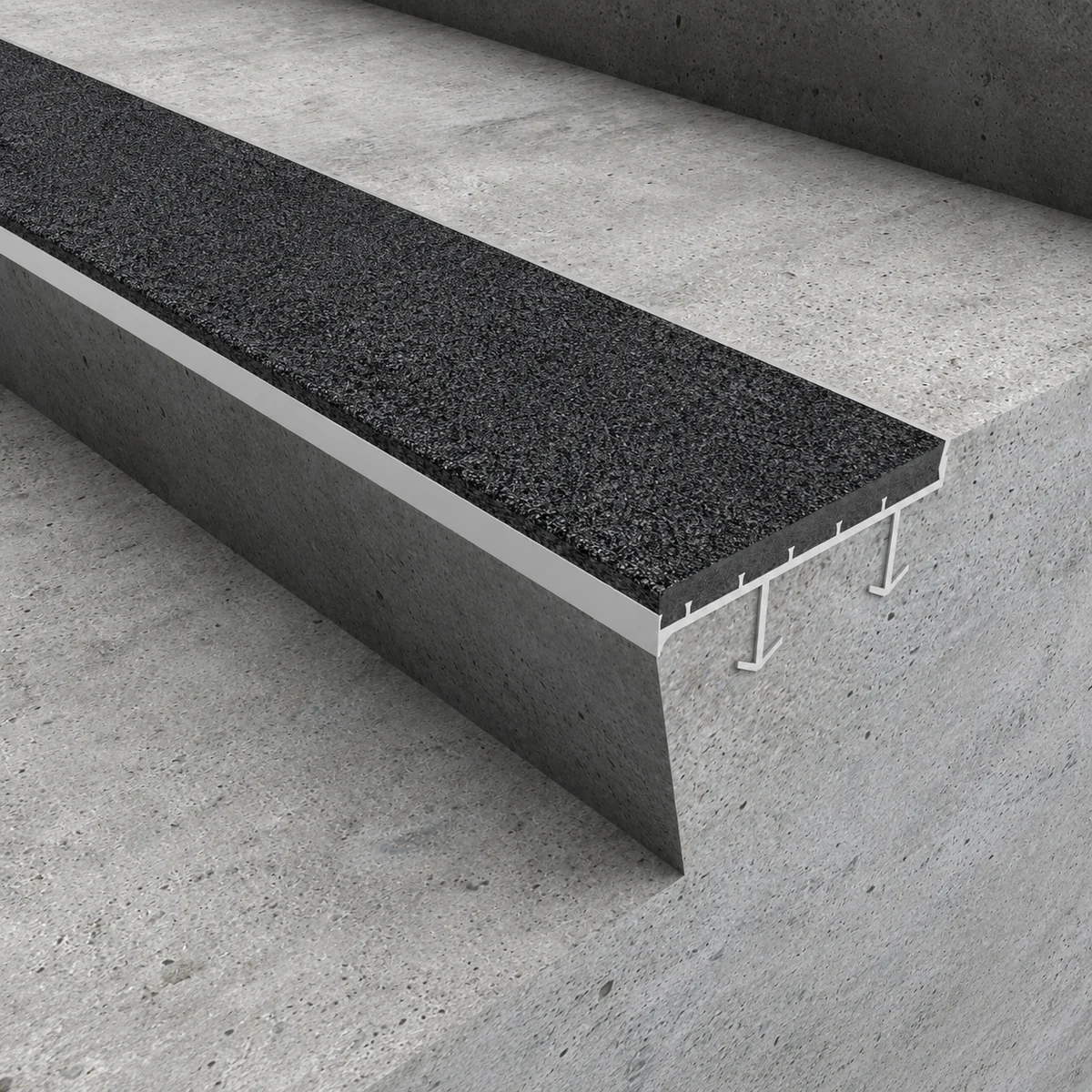
An insert-type profile has a metal base with a rubber, PVC, or abrasive strip. This allows the grip surface to be specified separately from the structural profile. Commercial ranges commonly include rubber inserts and carborundum-style abrasive inserts for higher-traffic applications.
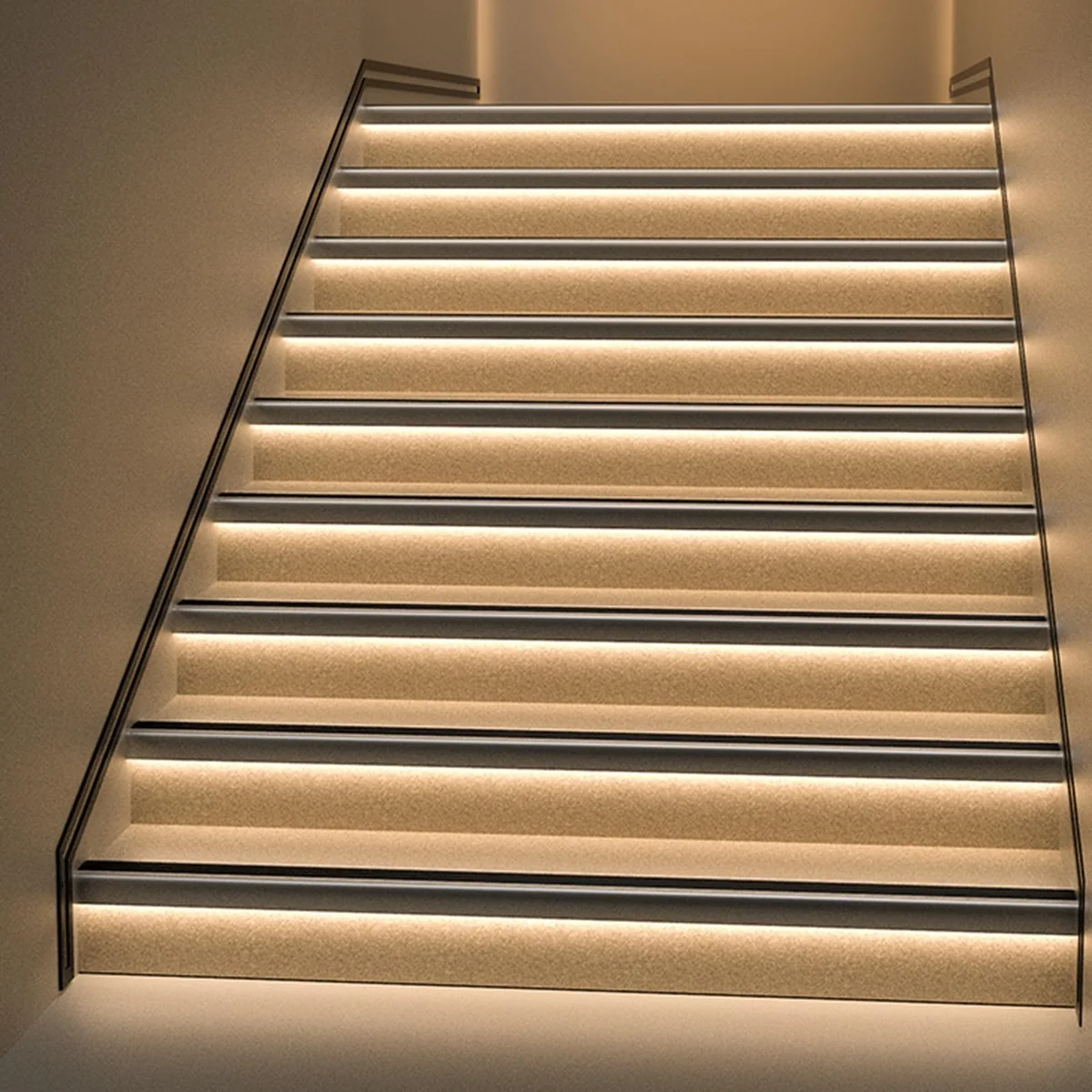
An illuminated profile can incorporate LED or photoluminescent elements to improve edge visibility in low-light conditions. The lighting component, cover durability, power arrangement, and maintenance access should be considered as part of the complete stair design.
Metal Stair Edge Nosing Safety Regulations: What Should Be Checked?
There is no single global stair nosing rule. A profile that is acceptable in one market may not meet another market’s dimensional or accessibility requirements. The project specification and the locally adopted code should therefore be checked before the profile is finalized.
United States: 2024 IBC
For means-of-egress stairs, the 2024 International Building Code addresses the nosing and riser profile in Section 1011.5.5. It states that nosings must have a curvature or bevel of at least 1/16 inch and no more than 9/16 inch from the foremost projection of the tread.
Section 1011.5.5.1 limits the nosing projection to 1 1/4 inches over the tread below, subject to the stated exception. Section 1011.5.5.2 also requires nosing projections within the flight to be uniform.
The IBC is a model code, so the edition adopted by the local jurisdiction and any local amendments should always be confirmed.
For specification work, this means metal stair edge nosing should be checked as part of the finished stair profile rather than as an isolated accessory. Adding a thick retrofit section can affect the final projection and dimensional consistency.
United States: ADA Standards
The 2010 ADA Standards require stair treads to have uniform riser heights and tread depths. Section 504.5 limits the radius at the leading edge to 1/2 inch maximum.
Where nosings project beyond the riser, their underside must be curved or beveled, and the permitted projection is 1 1/2 inches maximum over the tread below. The ADA guidance also advises designers to consider visual contrast at tread nosings or leading edges so steps are easier to identify for people with low vision.
It is important to distinguish an advisory recommendation from a mandatory dimensional rule. The federal ADA text does not establish one universal contrasting strip width for every staircase. Local accessibility codes may add further requirements.
United States: OSHA Workplace Stairs
OSHA 29 CFR 1910.25 requires workplace stairs covered by the standard to have uniform riser heights and tread depths between landings.
For standard stairs under the current rule, OSHA also specifies a maximum riser height of 9.5 inches, a minimum tread depth of 9.5 inches, and an installation angle between 30 and 50 degrees.
OSHA does not simply provide one universal dimension for a separate metal stair edge nosing strip. From a product standpoint, the important issue is that a retrofit profile should not interfere with the required stair geometry or create an inconsistent walking surface.
England: Approved Document M
For buildings other than dwellings in England, Approved Document M provides more specific guidance for stepped access.
The document states that nosings should be made apparent by a permanently contrasting material 55 mm wide on both the tread and the riser. It also advises avoiding a projecting step nosing where possible. Where a projection is necessary, it should not exceed 25 mm.
The same guidance notes that excessive rounding of nosings reduces the effective going of a tread. Its section on internal stairs refers back to the stepped-access design considerations, apart from differences relating to hazard warning surfaces.
Approved Documents provide statutory guidance on meeting the Building Regulations in England. They should still be applied according to the building type, project conditions, and approval requirements.
How to Choose the Right Metal Stair Edge Nosing

Start With the Stair Construction
For new tile or stone stairs, an embedded profile usually gives the cleanest result. The perforated anchoring leg is installed with the floor finish so the top surface can sit flush.
For existing stairs, surface-mounted metal stair edge nosing is normally more practical. It can cover a damaged corner without removing the complete tread finish. Before selecting it, measure the existing stair carefully and check whether the added thickness changes the nosing geometry.
Match the Surface to the Traffic Level
A lightly used interior stair may only need a grooved aluminum surface. A busy public staircase may justify a replaceable anti-slip insert or abrasive strip.
The correct question is not simply, “Which surface has the most grip?” Very aggressive inserts can be harder to clean and may collect more dirt. The objective is suitable slip resistance for the actual operating conditions.
Consider Wet and Exterior Conditions
Water can significantly change the performance of a walking surface. Exterior stairs also expose the profile to dirt, temperature changes, weather, and corrosion.
For these projects, select the metal grade and finish together with the anti-slip surface. Drainage also matters. Even a high-grip metal stair edge nosing should not be expected to compensate for water collecting at the front of the tread.
Check Contrast Early
If a code or project specification requires a contrasting stair edge, decide the color before production.
An insert, anodized finish, powder coating, or separate contrasting strip can be considered depending on the construction. This is easier to control during drawing and sample approval than after bulk production has started.
Installation Details That Affect Performance
Good material cannot compensate for poor installation. Problems with metal stair edge nosing often come from movement, uneven fixing, incorrect cuts, or poor alignment.
For tile-in profiles, the anchoring leg should be fully supported and integrated into the flooring installation. The finished tile and metal surface should meet cleanly without an unsupported void at the edge.
For surface-mounted profiles, the substrate must be sound and reasonably flat. Screws should finish flush with the profile, while adhesives must be compatible with both the metal and the stair substrate. Raised fastener heads can create exactly the hazard the nosing was intended to reduce.
At corners and ends, cut edges should be deburred. A clean cut prevents exposed sharp metal and helps adjacent sections align correctly.
Manufacturer’s Tip: Approve both the cross-section drawing and a physical sample before mass production. Where possible, fit the sample to the actual stair build-up. This makes projection, profile height, insert fit, and finish problems much easier to identify before a bulk order is released.
What B2B Buyers Should Confirm Before Bulk Ordering
For standard or custom metal stair edge nosing, the technical drawing should be the starting point rather than the catalog photo.
Before approving production, confirm the material grade, cross-section dimensions, surface finish, profile length, dimensional tolerances, insert specification, fixing details, and packaging requirements. In procurement work, these details make it much easier to compare quotations from different suppliers on an equal basis.
For repeat distribution programs, batch consistency is equally important. Approved drawings and finish samples should be retained as production references.
As a direct manufacturer, Chenhao Aluminum Business can supply standard aluminum stair profiles as well as custom sections developed around specific project requirements. OEM services can cover profile dimensions, punching arrangements, finishes, inserts, lengths, and packaging.
Factory-direct production can also support competitive pricing and more stable quality control for bulk orders. For international projects, production and packing can be planned around container quantities or other global shipping requirements.
The useful part of customization is not adding unnecessary complexity. It is making sure the metal stair edge nosing fits the staircase, installation method, safety specification, and purchasing program.
Maintenance and Inspection
Metal stair edge nosing should be included in normal stair inspection. Look for movement, loose fasteners, lifted insert edges, excessive wear, corrosion, or debris trapped in the anti-slip surface.
Replace damaged inserts before they become loose. If a surface-mounted profile begins to move, investigate the substrate and fixing method rather than simply adding more adhesive over the existing installation.
Cleaning products should also suit both the metal finish and the insert material. A chemical that is acceptable for stainless steel may not be suitable for rubber inserts, powder coatings, or some anodized finishes.
FAQs About Metal Stair Edge Nosing
Is Aluminum or Stainless Steel Better for Stair Nosing?
Neither material is automatically better.
Aluminum is lighter, easier to process, and often more economical for general projects. Stainless steel is useful where higher impact resistance, intensive cleaning, or a demanding exposure condition is expected.
The environment and profile design matter more than the metal name alone.
Can Metal Stair Edge Nosing Be Installed on Existing Stairs?
Yes. L-shaped and other surface-mounted profiles are designed specifically for retrofit work.
The existing tread must be stable, and the added metal stair edge nosing should be checked for thickness, projection, fixing method, and consistency before installation.
Does Stair Nosing Have to Be a Contrasting Color?
Not in every jurisdiction.
Some regulations or project specifications provide specific contrast requirements, while others make recommendations. For example, the federal ADA Standards advise considering visual contrast, while England’s Approved Document M gives specific 55 mm contrasting-material guidance for the stepped access it covers.
Always check the accessibility requirements that apply to the actual project location.
Is a Wider Anti-Slip Insert Always Safer?
No. Insert width is only one factor.
Surface texture, contamination, water, wear, footwear, installation level, and the specified test method can all affect performance. Choose the insert according to the project requirements rather than assuming the widest option will automatically provide the safest result.
Conclusion
Metal stair edge nosing is a small component with a direct effect on stair durability, visibility, and walking safety. The correct profile should protect the tread edge without creating an excessive projection or raised lip, and its surface should suit the expected traffic and environment.
When these details are handled correctly, metal stair edge nosing becomes more than a decorative trim. It becomes a controlled part of the stair system—one that protects the edge, supports safer use, and reduces avoidable repair work over the life of the project.